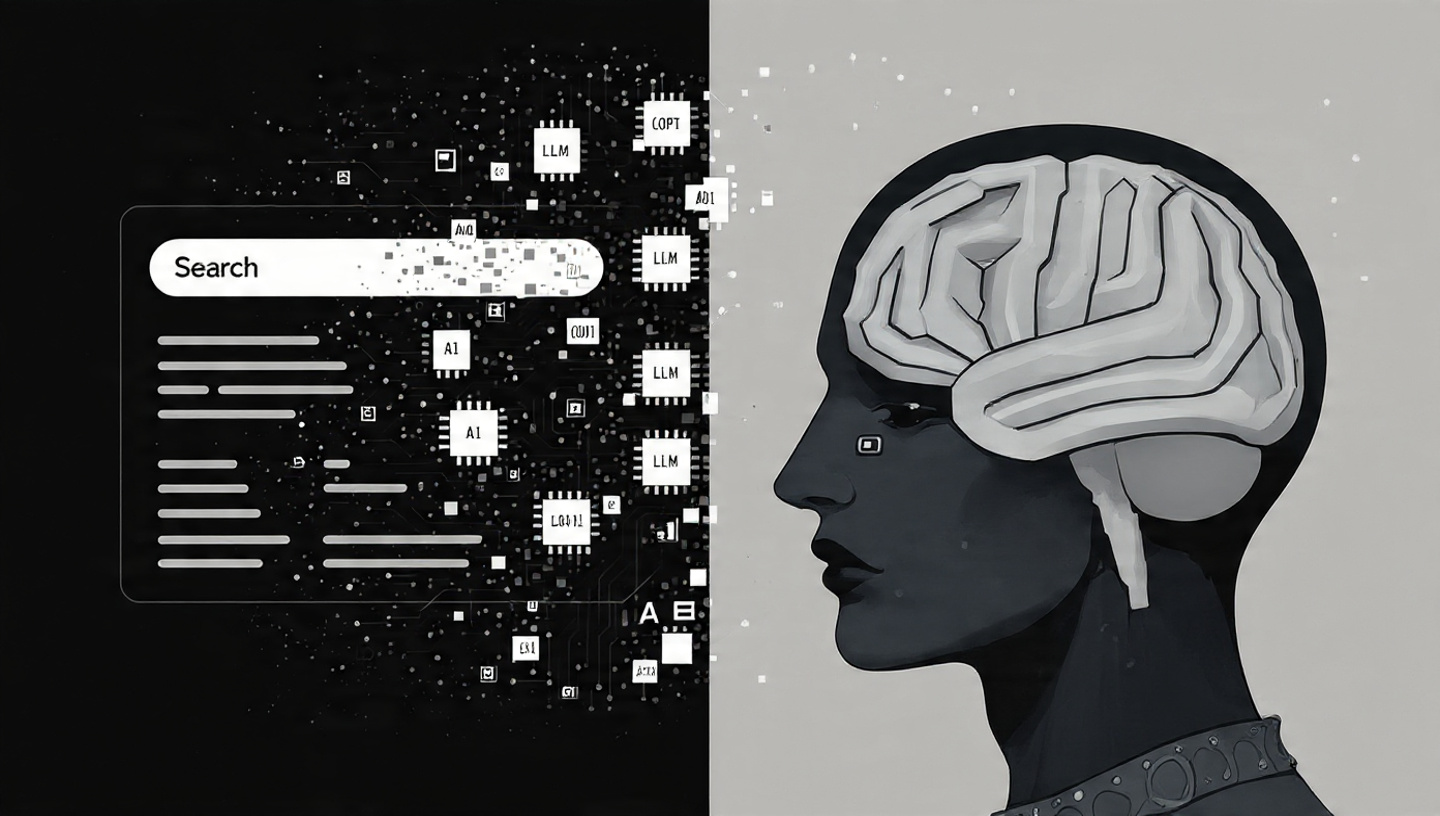
I Googled something harmless the other day: "How do I make a tiny Chrome extension that auto-plays YouTube videos at 2× speed?"
Before I could blink, the search engine gave me the code. No blog links. No scrolling. No funnels. No "Top 10 Tips For Productivity Apps in 2025". Just clean code and a "you're welcome" vibe.
That's when it hit me: Google isn't sending traffic to blogs anymore. Google is the blog.
Every SEO "expert" is screaming "SEO IS DEAD!!" No. SEO just got honest. The old version (keyword farming, listicles, 3,000-word fluff pieces designed to manipulate algorithms) that version deserves to die. The new SEO is something completely different: being the source AI chooses to quote.
Why AI Killed Content Farms (And Why That's Good)
Back in 2018-2023, the formula was painfully predictable. Find a keyword with decent search volume, write a blog that's just a remix of the top five Google results, add a stock photo of someone pointing at a chart, and call it "valuable content." Blogs were factories, not writing. The content wasn't written to help people. It was written to game algorithms.
If you ever searched "best laptops for programming," you know exactly what I'm talking about. Sixteen blogs recommending the same five laptops, copy-pasted Amazon affiliate links, written by someone who probably hasn't touched code in years. None of them actually tested the laptops. None of them had real opinions. They just regurgitated specs from manufacturer websites and called it a day.
AI ended that game completely. Why would anyone read your fake experience article when ChatGPT can summarize ten sources into one clean answer? AI exposed what was always true: most blogs don't teach, most content doesn't add value, and most "content creators" aren't experts they're keyword farmers optimizing for traffic, not truth.
Here's what people miss when they say "AI killed SEO." AI didn't kill anything valuable. It killed mediocrity. It killed the illusion that you could build a sustainable content business by repackaging other people's work. The blogs that are dying were already dead inside they just hadn't realized it yet.
The content that survives AI isn't the content that ranks highest. It's the content that can't be replicated by summarizing ten other sources. It's the stuff that comes from actually doing the thing you're writing about. When I wrote about building 2XFun, my browser extension, I didn't research "how to build browser extensions." I built one, shipped it, learned what worked, and wrote about that experience. That's something AI can't fake.
AI can generate a perfectly formatted blog post about "10 Best Practices for Browser Extensions." It can pull from documentation, Stack Overflow, and a dozen other sources to create something that looks authoritative. But it can't tell you what it feels like to spend three hours debugging a manifest.json file at 2 a.m., or how satisfying it is when users actually thank you for solving their tiny frustration. That lived experience is what separates content that matters from content that's just filling space.
The blogs panicking about AI are the ones that never had original ideas to begin with. They built their entire strategy on arbitrage finding gaps in Google's algorithm and filling them with mediocre content before anyone else did. Now that the arbitrage opportunity is gone, they're lost. Good. That business model was always exploitative, both to readers and to search engines.
What AI Actually Rewards (And What It Doesn't)
Here's the part that confuses people: AI doesn't replace original ideas. It replaces generic ones. There's a massive difference, and understanding it is the key to winning in post-AI search.
Ask ChatGPT to "write a blog on how Android is open source" and it'll give you a perfect answer. Clean, correct, comprehensive, and boring as hell. It'll explain AOSP, licensing, the difference between open and proprietary components, all formatted beautifully. A blog written by AI for people who don't actually care about the topic.
Now ask it to "tell me what it feels like to build a custom ROM and realize Google controls Android more than you thought." It freezes. Because that's not information you can summarize from documentation. That's experience. That's the moment when theory crashes into reality and you learn something that can't be Googled.
When I wrote about Android's fake openness, the line that resonated wasn't the licensing explanation or the technical breakdown. It was this: "I pulled down AOSP expecting the full Android experience. What I got was a half-baked shell. No Play Store. No Gmail. No Maps. Just sadness."
People messaged me about that specific line. Not because it was technically accurate (though it was), but because it captured a feeling they'd experienced themselves or helped them understand something abstract through a real moment. AI can't generate that. It can mimic the format, but it can't replicate the specific disappointment of flashing AOSP onto a phone and realizing you've basically bricked it for practical purposes.
This is where the new SEO lives: in the gap between what AI can summarize and what only humans can experience. When you write from that place, you're not competing with AI. You're creating the raw material that AI summarizes and cites. You become the source, not the middleman.
The clearest way I can explain this: anyone can write "target long-tail keywords to improve SEO rankings." It's technically correct, widely repeated, and completely useless because it tells you nothing actionable. Only you can write "my tutorial finally ranked when I replaced the boring intro with a story about almost rage-quitting the project." That's specific, memorable, and impossible to generate without having done the actual work.
AI amplifies truth and destroys bullshit. If your content is built on real experience, AI makes it more discoverable by summarizing and citing you in responses. If your content is just repackaged generics, AI makes you obsolete by doing the same thing faster and better. The incentive structure finally aligns with quality instead of quantity, which is exactly what should have happened years ago.
How SEO Actually Works Now
The future of SEO isn't about ranking high. It's about being irreplaceable. When people say "SEO is dead," what they mean is "my factory-produced blog posts don't work anymore." Good. Let bad writing die. Let experience win.
Here's what works in post-AI SEO: write like a human, format like a machine. Humans want stories, mistakes, opinions, and narrative. AI wants structure, clarity, bullets, and summaries. When you mix both, you create content that humans love and AI can reference. That's the sweet spot.
Bad example: "SEO is important because higher ranking means more visibility, which leads to increased traffic and conversions." This is the kind of sentence that sounds authoritative but says nothing. AI generates this stuff in milliseconds.
Good example: "I wrote a 2,000-word guide that ranked nowhere until I deleted the generic intro and added a screenshot showing how I completely broke my production build. Nobody cares about 'importance.' They care about results, mistakes, and what you learned from both."
See the difference? The second version is opinionated, specific, and grounded in something that actually happened. It can't be replicated by summarizing ten other sources because it comes from a lived experience that didn't exist before you wrote about it.
Your SEO ranking now depends on these questions: Are you saying something new? Did you actually do the thing you're writing about? Would a human share this or quote it? Would an AI model consider it a useful source? If the answer is yes to all four, you win. If not, AI will rewrite your idea faster than you can spell "backlink."
The shift isn't subtle. Google used to reward content any content that matched search intent and had the right technical setup. AI rewards proof. Show your work. Share your mistakes. Post screenshots of your broken prototypes and explain what went wrong. Give people the raw, unfiltered version of building something, not the polished press release version.
This doesn't mean you abandon structure or clarity. AI still needs to parse your content, which means headers, bullet points, and clean formatting matter more than ever. But the content inside that structure has to be yours. Your story. Your perspective. Your mistakes and successes. That's what makes it citation-worthy.
Most people write to rank. Write to matter instead. Not because it's morally superior, but because it's the only strategy that works when AI can replicate everything else. You don't need more content. You need more stories. And stories real, specific, personal stories are something no AI can steal from you.
The bottom line: AI didn't kill SEO. It killed lazy SEO. If you're copying other blogs, you're screwed. If you're writing from real experience, you're untouchable. The game didn't end. The rules just got honest.