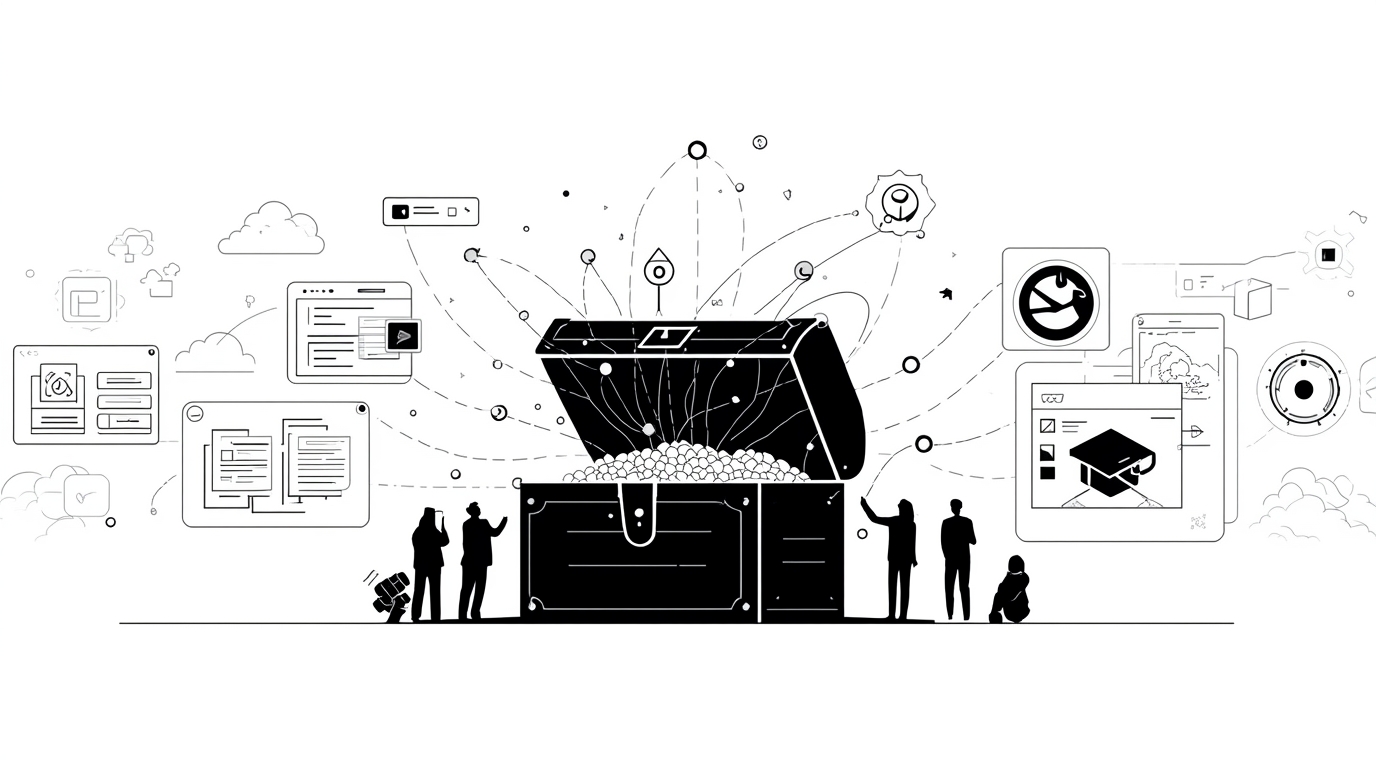
 My friend called me crazy when I told him I was contributing to Cal.com, an open source scheduling platform. "Why would you work for free on something that's already free?" he asked. "How do they even make money?"
Six months later, Cal.com raised $25 million and is building a legitimate business around their free, open source calendar tool. My friend still thinks I'm crazy, but now he's asking how this whole "give everything away and somehow get rich" thing actually works.
Here's the thing that blows most people's minds: some of the most valuable tech companies in history built their entire business on open source software. Red Hat sold to IBM for $34 billion. MongoDB is worth over $20 billion. Elastic, GitLab, HashiCorp. All built on code that anyone can download, modify, and use for free.
The traditional business logic says this should be impossible. You can't build a profitable company by giving away your core product for free. Except you absolutely can, and the companies that figure out how to do it right often dominate their entire industry.
The secret isn't in the code. It's in understanding what customers actually pay for.
When I started contributing to open source projects, I thought the business models were straightforward. Make free software, charge for support, profit. That naive view lasted about five minutes into reading actual company strategies. The reality is way more sophisticated, and way more interesting.
Most people think open source companies fail because they can't monetize free software. The truth is the opposite. Open source companies fail when they don't understand the difference between their product and their business. The code is the product. The business is everything else customers need to actually use that code in production.
Let me break down how this actually works, because once you see the pattern, you'll understand why open source isn't just a viable business model. It's often the dominant one.
The Economics Nobody Talks About
Traditional software companies spend massive amounts on customer acquisition. They build sales teams, run ads, attend conferences, and pray someone will try their closed, proprietary solution. Open source companies flip this entire model.
Instead of convincing people to try your software, you make it so good and so accessible that developers naturally gravitate toward it. Every GitHub star, every Stack Overflow answer, every blog post about your project becomes free marketing. Developers become your unpaid sales force because they genuinely love using your tools.
Cal.com gets this. They built a scheduling tool that's genuinely better than Calendly for many use cases, made it completely open source, and let the developer community discover it organically. No massive ad spend, no aggressive sales tactics. Just good software that solves real problems.
This creates what economists call a "network effect." The more people use your open source project, the more valuable it becomes. More users mean more contributors, more features, better documentation, and stronger community support. This makes it even more attractive to new users, creating a virtuous cycle that's incredibly hard for closed source competitors to break.
But here's where it gets really interesting from a business perspective. All those free users aren't just costs you're absorbing. They're your R&D department, your QA team, and your product marketing all rolled into one. They find bugs you'd never catch, build features you'd never think of, and advocate for your solution in ways no paid marketing could achieve.
The companies that understand this don't see free users as a drain on resources. They see them as the foundation of a business model that scales better than any traditional software company ever could.
The Three Models That Actually Work
Most people think there's only one way to monetize open source: charge for support. That's like saying there's only one way to monetize a website: banner ads. The reality is much more nuanced, and the successful companies usually combine multiple approaches.
The Open Core Strategy is probably the most common approach. You open source the core functionality that gets people hooked, then charge for enterprise features that businesses actually need. MongoDB does this perfectly. Their core database is completely free and open source. But if you want advanced security, monitoring, or management tools, you pay for MongoDB Atlas or Enterprise Advanced.
The genius here is that developers fall in love with the free version, build applications on it, and then their companies naturally upgrade when they need enterprise capabilities. You're not selling to developers. You're selling to the businesses that employ developers who already chose your technology.
The Hosted/Cloud Strategy takes your open source software and sells it as a managed service. Customers get all the benefits of your software without the headache of running it themselves. They're not paying for the code. They're paying for convenience, reliability, and not having to hire DevOps teams.
GitLab exemplifies this approach. You can download and run GitLab on your own servers for free. But most companies would rather pay GitLab to host, maintain, and scale their Git repositories rather than deal with that complexity internally. Same software, completely different value proposition.
The Dual Licensing Model is the most aggressive approach. You offer your software under two licenses: a free open source license with restrictions (usually around commercial use), and a paid commercial license for businesses that need more flexibility. This works particularly well for developer tools and infrastructure software.
Cal.com uses elements of this strategy. The core scheduling functionality is open source, but they offer Cal.com Cloud as a hosted solution for teams that want the benefits without the setup complexity. They're also building premium features and integrations that make sense for businesses but aren't necessary for individual users.
The key insight across all these models is that you're not selling software. You're selling outcomes. Businesses don't want to run databases, manage Git repositories, or configure scheduling systems. They want their applications to work, their code to be safe, and their meetings to be organized. Open source gives them confidence in the underlying technology, while paid services deliver the business outcomes they actually care about.
Why This Strategy Dominates Tech
There's a reason why open source business models keep winning in competitive markets. It's not just about the economics. It's about trust, transparency, and long-term thinking that resonates incredibly well with technical buyers.
When a developer evaluates closed source software, they're making a leap of faith. They don't know how it works internally, they can't fix bugs themselves, and they're completely dependent on the vendor for updates and improvements. With open source software, they can read the code, understand the architecture, and have confidence that they're not locked into a black box solution.
This trust factor becomes crucial as companies scale. CTOs making infrastructure decisions aren't just buying software for today. They're making choices they'll live with for years. Open source gives them an escape hatch. Even if the company behind the software disappears or makes bad decisions, the code will still exist and can be maintained by the community or internally.
The transparency of open source also accelerates innovation in ways that closed source software can't match. When Netflix built their entire streaming infrastructure on open source tools, they didn't just use the software. They contributed improvements back to the community, making the tools better for everyone. This creates a positive feedback loop where the biggest users become the biggest contributors, constantly improving the product for everyone.
From a competitive perspective, this creates incredibly strong moats. Once an open source project gains momentum, it becomes very difficult for closed source competitors to catch up. Why would developers choose a proprietary alternative when there's a battle-tested, community-driven solution that's constantly improving?
Companies like Docker, Kubernetes, and React didn't just win their respective markets. They essentially ended the competition. Once these tools reached critical mass in the developer community, alternative approaches became irrelevant almost overnight.
The Mistakes That Kill Open Source Startups
Not every open source company succeeds, and the failures usually follow predictable patterns. The biggest mistake is treating open source as a marketing strategy instead of a core business strategy. Companies that slap an open source license on mediocre software and expect the community to do the hard work of building a business around it are usually disappointed.
The community can smell insincerity from miles away. If your open source project feels like a demo version of your real product, developers will find alternatives. If your documentation is poor, your contribution process is complicated, or your company doesn't engage authentically with users, the network effects work against you instead of for you.
Another common mistake is optimizing for the wrong metrics. Companies that focus obsessively on GitHub stars or download numbers without thinking about conversion to paid services often build impressive-looking projects that generate no revenue. The goal isn't to maximize free usage. It's to build a sustainable funnel from free users to paying customers.
Timing matters too. Open sourcing too early, before your software is genuinely useful, means you'll never build the community momentum you need. Open sourcing too late, after competitors have established themselves, means you're playing catch-up in a market that's already moving toward other solutions.
The companies that succeed treat open source as a long-term investment in building the best possible solution to a real problem. They engage authentically with their communities, build genuinely useful software, and create clear paths from free usage to paid value. It's not a get-rich-quick scheme. It's a patient, strategic approach to building technology businesses that can dominate their markets for decades.
The Bottom Line for Entrepreneurs
If you're thinking about building an open source business, here's what actually matters: start with a problem that developers face regularly, build something genuinely better than existing solutions, and make it ridiculously easy for people to get started with your software.
Focus on creating value for your free users first. A thriving community of happy free users is the foundation everything else builds on. But always have a clear vision for how businesses will pay you for additional value. Whether that's hosting, support, premium features, or professional services, you need a path from free to paid that makes sense for your specific market.
Don't underestimate the complexity of building and maintaining a community. It's not just about writing code. It's about documentation, communication, user support, and creating an environment where other developers want to contribute. This is often harder than building the initial software.
But if you get it right, you're not just building a business. You're building a movement. And movements, especially in technology, tend to be more durable and more valuable than traditional companies. The developers who contribute to your project become invested in its success. The companies that build on your software become stakeholders in your ecosystem.
That's not just a business model. It's a competitive advantage that's almost impossible to replicate through traditional means. And in a world where software is eating everything, that advantage might be the most valuable thing you can build.