I was looking at the industry data last week, and the numbers are frankly terrifying. If you work in media, marketing, or content creation, you have likely felt the shift intuitively. But when you see the raw statistics, it stops being a "feeling" and starts looking like an extinction event.
Traditional media brands the institutions we thought were too big to fail are dying. This isn't hyperbole; it is a mathematical certainty based on the current trajectory of the internet.
I recently published a comprehensive whitepaper, Beyond Platform Dependency: The Constellation Model for Next-Generation Media, which breaks down exactly why this collapse is happening and, more importantly, provides a blueprint for what comes next.
Here is the reality: The "traffic hose" that publishers relied on for two decades has been turned off.
The Structural Collapse of the Old Internet
For the last 15 years, the deal was simple: You write content, Google indexes it, and Facebook shares it. In exchange, they send you traffic, which you monetize with ads. That deal has disintegrated.
My research for the whitepaper uncovered some staggering figures:
- The Zero-Click Reality: "Zero-click" searches now account for 58.5% of all Google queries. Most users never visit a publisher's website anymore; they get their answer right on the results page.
- The AI Impact: When Google's AI Overviews appear, click-through rates for publishers drop by 47.5% on desktop and 37.7% on mobile.
- The Traffic Crash: Major news publishers collectively lost over 600 million visits between May 2024 and May 2025.
This is not a temporary dip. This is a permanent structural change. The era of "renting" audiences from Big Tech is over. If your business model depends on SEO volume and programmatic display ads where CPMs have fallen 37% since 2021 you are building on quicksand.
So, if the old model is dead, what replaces it?
The False Solution: The "Solo Creator" Trap
In response to this collapse, we’ve seen a massive swing toward the "Creator Economy." Journalists are leaving newsrooms to start Substacks; video producers are going independent on YouTube.
The narrative is that the individual is the new media company. And while it is true that audiences now trust people more than brands (a shift toward para-social relationships), the Solo Creator model has a fatal flaw: Sustainability.
A solo creator is a single point of failure. They must be the writer, the editor, the marketer, the salesperson, and the legal department. The data shows that this leads to massive burnout and inconsistency. When the creator stops, the business stops. There is no enterprise value, no legacy, and no safety net.
We need a middle path. We need a model that captures the audience connection of a creator but retains the stability and scalability of a traditional media house.
Enter: The Constellation Model
In my whitepaper, I introduce a framework I call The Constellation Model.
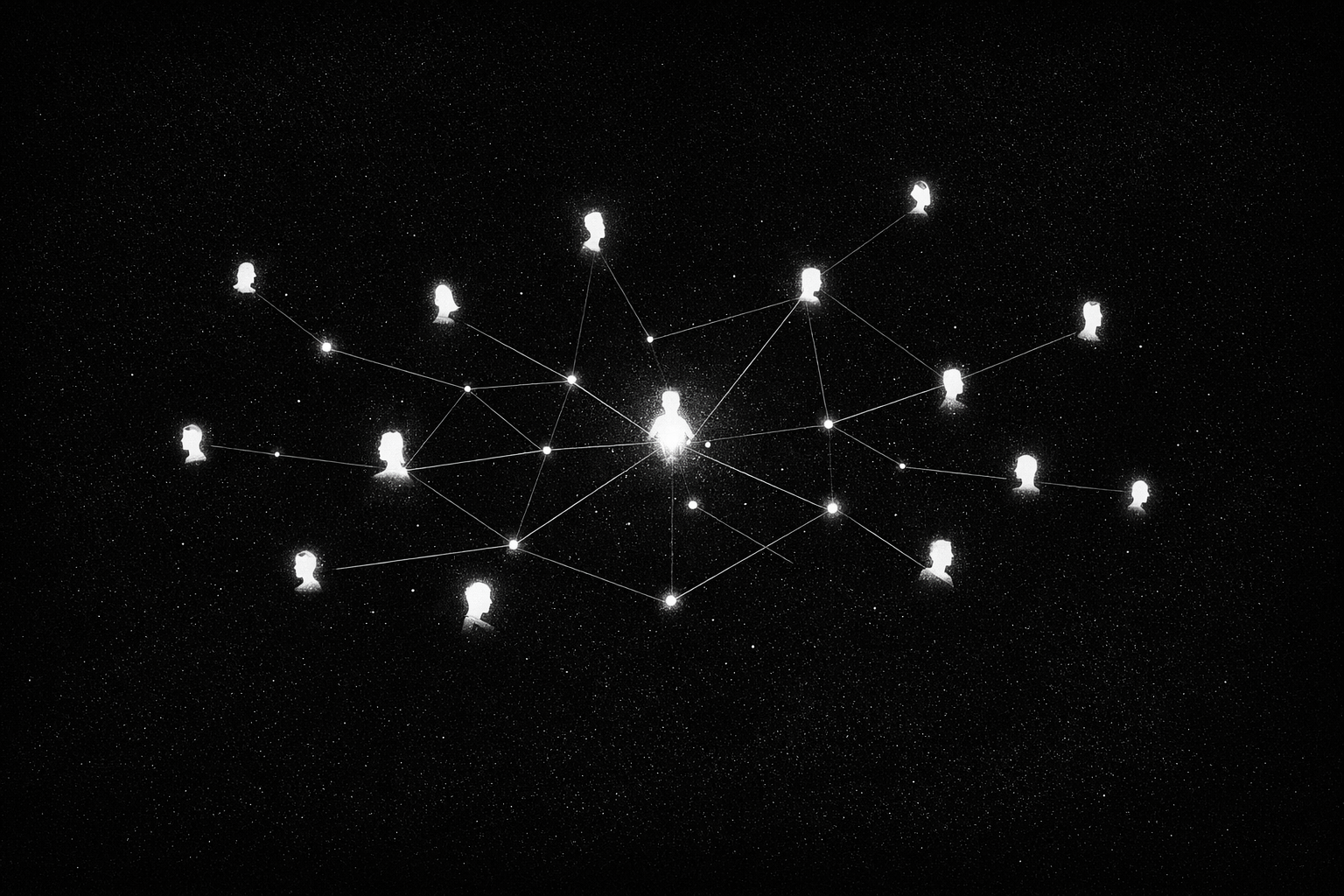
Think of a constellation. It is made up of individual stars that shine brightly on their own, but they are connected by an invisible structure that gives them greater meaning and form.
In this model, the media company acts as the "Central Hub," providing the boring-but-essential infrastructure:
- Legal and compliance
- Ad sales and sponsorship negotiation
- Tech stack and analytics
- HR and operations
Orbiting this hub are the "Satellite Creators." These are journalists or personalities who retain their unique voice, their personal social handles, and their direct relationship with the audience. They aren't just employees filling a "content quota"; they are partners operating under a unified banner.
Why This Works (The Data)
We are already seeing early versions of this model succeed where legacy media fails.
- Morning Brew scaled to 4 million subscribers and $70M+ in revenue not by being a "news site," but by building distinct, personality-driven verticals (like Marketing Brew and HR Brew).
- The Hustle was acquired by HubSpot for $27M using a similar lean, personality-first approach.
- Barstool Sports is perhaps the most aggressive example, where the brand is essentially a network of autonomous podcasts and personalities sharing a back-office infrastructure.
The Constellation Model solves the two biggest problems in media today:
- For the Creator: It removes the administrative burden, preventing burnout and allowing them to focus on creating.
- For the Business: It de-risks the company. If one "star" leaves, the constellation remains. It also allows for cross-pollination of audiences using the traffic from a massive generalist newsletter to launch a niche paid product, for example.
The Blueprint: How to Build a Constellation
In the whitepaper, I outline a detailed implementation blueprint. Here is the simplified version of how you build this in 2025:
1. Validate the Niche (The Micro-Monopoly)
Stop trying to build "The New York Times for X." Start with a micro-niche. The goal is to be the single most authoritative source for a specific group of 10,000 people, not a general source for 10 million. If you can’t get 10% of your audience to open a newsletter, you don't have a media company; you have a traffic accident.
2. Own the Distribution
Do not build on rented land. Your primary asset must be an owned channel usually an email list or a podcast feed. Social media is for discovery, not distribution. The data shows that social platforms have reduced external link reach by 40–67%. You cannot rely on them to deliver your content to your followers.
3. Diversify Monetization Immediately
The Constellation Model does not rely on one revenue stream. The blueprint suggests a healthy mix:
- Sponsorships (30%): High-value, direct deals (not programmatic).
- Subscriptions (40%): Paid memberships for premium analysis.
- Products/Events (30%): Digital courses, physical merch, or conferences.
4. The "Hub and Spoke" Expansion
You start with one "Star" (usually the founder). Once that star is profitable, you use the profits to recruit a second star in an adjacent niche. You plug them into your existing infrastructure (the Hub). Suddenly, your overhead costs per creator drop, while your total revenue doubles.
The Future Belongs to the Agile
The media companies that survive the next decade won't be the ones with the biggest legacy newsrooms. They will be the ones that understand the shift to para-social relationships and build infrastructure to support it.
The "Zero-Click" future isn't coming; it's here. The 15,000 media jobs lost in 2024 are a testament to the brutality of this transition. But for those willing to adapt, the opportunity is massive. We are moving from an era of volume (billions of pageviews) to an era of value (millions of engaged, trusting fans).
If you are a founder, investor, or creator, you need to understand the mechanics of this shift.
I’ve made the full research paper available for free. It contains the complete data sets, the unit economics of the Constellation Model, and the step-by-step guide to restructuring your media operation.