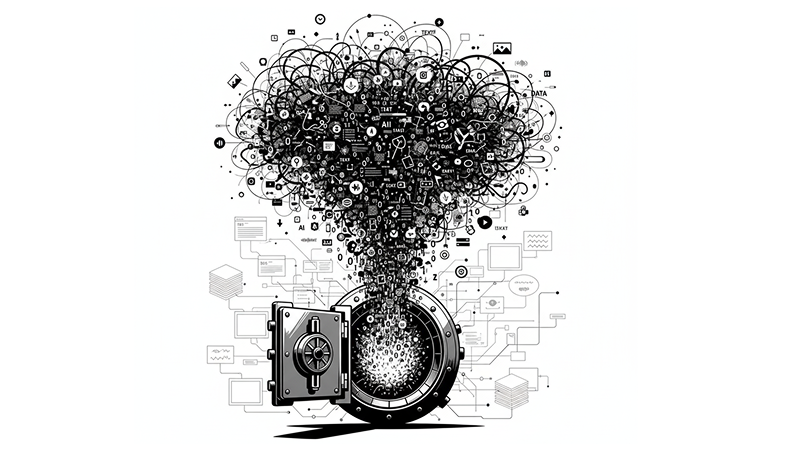
I was scrolling through LinkedIn last week when I saw another "hot take" about AI companies hitting a data wall. The post claimed we'd "run out of internet data by 2026" and AI progress would screech to a halt. It got thousands of likes and hundreds of shares from people nodding along like this was some inevitable doom.
Here's the thing: that take fundamentally misunderstands how AI training actually works in 2025. The idea that companies like OpenAI, Google, or Meta will just throw their hands up and say "welp, we've read everything on the internet, pack it up folks" is like saying Netflix will run out of shows because they've filmed every possible story.
The reality is way more interesting, and the business implications are huge.
Let me paint you the picture that's got everyone worried. The internet has roughly 50-100 trillion words of text (depending on how you count). Training modern AI models requires massive datasets. GPT-4 was trained on something like 10-15 trillion words. At this rate, the logic goes, we'll scrape everything useful by 2026 and hit a wall.
This sounds logical until you realize it's based on a completely outdated understanding of how AI training works. It's like saying we'll run out of music because there are only so many combinations of notes. Technically true, practically meaningless.
Here's what actually happened when I started paying attention to how AI companies talk about their training: they stopped bragging about dataset size years ago. Early models were trained like digital hoarders. Throw everything at the wall and see what sticks. Reddit comments, random blog posts, Wikipedia dumps, whatever. More data meant better results, period.
But somewhere around 2023, the smart money realized something crucial: one high-quality conversation is worth a thousand random forum posts. One well-structured coding example beats ten thousand lines of random GitHub repositories. The shift is already happening. Companies are investing millions in what they call "synthetic data generation." Instead of scraping more internet junk, they're creating perfect training examples designed specifically for what they want their AI to learn.
Think of it like the difference between learning guitar by listening to every song ever recorded versus getting lessons from a master guitarist who designs exercises specifically for your skill level.
The Data Manufacturing Revolution
This is where it gets fascinating from a business perspective. AI companies aren't just consuming data anymore. They're manufacturing it.
Here's how it works: you use your existing AI to generate training scenarios, conversations, and examples that are cleaner and more targeted than anything you'd find naturally occurring online. Then you use that synthetic data to train the next generation of models. It sounds like science fiction, but it's happening right now. Anthropic trains Claude partly on AI-generated conversations. OpenAI uses GPT models to create training data for future GPT models. Google's been doing this for years with their various AI systems.
The kicker? Synthetic data can be infinite. You can generate millions of customer service conversations, coding examples, creative writing samples, whatever you need. The only limit is computing power, and that's getting cheaper every quarter.
But let's say synthetic data wasn't enough (it is, but let's pretend). The "we're running out of internet text" crowd is ignoring massive data sources that barely get mentioned. Every Slack workspace, every Discord server, every WhatsApp conversation contains training gold. Companies are already figuring out privacy-preserving ways to learn from this data without violating user trust.
Every time someone uses ChatGPT, Claude, or Bard, they're generating new training examples. Millions of conversations daily, each one teaching the AI what humans actually want and how they want it delivered. Text is just one format. Images, audio, video, sensor data from IoT devices, user interaction patterns. We're drowning in data types that most models barely use yet.
Every company has proprietary documents, internal communications, and specialized knowledge that could train industry-specific AI models. We're talking about trillions of words locked away in corporate databases. The internet text everyone's worried about? That's maybe 5% of the total data universe AI companies could potentially access.
There's another angle everyone misses: AI models are getting dramatically more efficient. GPT-3 needed 175 billion parameters to achieve its results. Newer models are achieving better performance with fewer parameters trained on less data. It's like the difference between a gas-guzzling V8 and a hybrid engine. Both get you where you're going, but one does it with way less fuel.
Companies are investing heavily in "data efficiency." Making models that learn more from every training example. This means that even if we did have a fixed amount of useful data (we don't), we'd be able to extract more value from it over time.
What Smart Companies Actually Understand
Here's what recruiters and business leaders need to understand: the companies winning the AI race aren't the ones with the most data. They're the ones with the best data strategies.
Meta doesn't need more Facebook posts to train better AI. They need better methods for identifying which posts actually improve their models and which ones just add noise. Google isn't scraping harder to find more web pages. They're getting better at extracting value from the data they already have access to through Search, YouTube, Gmail, and Android.
Microsoft isn't running out of training material. They're sitting on decades of Office documents, GitHub code, and now ChatGPT conversations that give them insights no other company can match. The competition isn't about who can grab the most data from the internet commons. It's about who can create the most effective training pipelines from their unique data advantages.
If you're making decisions based on the assumption that AI progress will stall due to data constraints, you're planning for a problem that won't exist. Here's what will actually matter: Data partnerships become crucial. Companies with unique data sources (healthcare, finance, manufacturing) will become increasingly valuable as AI partners.
Quality curation becomes a competitive advantage. The ability to identify and clean valuable training data will matter more than the ability to collect massive amounts of random data. Synthetic data expertise matters too. Companies that get good at generating high-quality synthetic training data will have sustainable advantages over those still scraping the web.
Real-time learning systems will dominate. AI that can learn and improve from user interactions will outperform static models trained once and deployed forever.
The Real Bottleneck Nobody Talks About
The actual constraint isn't data. It's compute power and energy. Training advanced AI models requires massive server farms running for months. That's expensive and environmentally intensive. But even this bottleneck is temporary. Hardware is improving, training methods are getting more efficient, and companies are building dedicated AI infrastructure at unprecedented scales.
So why does the "AI data shortage" story keep popping up? Because it's intuitive. We understand scarcity. We don't intuitively understand exponential improvement in data efficiency, synthetic data generation, or multimodal training pipelines. It's the same reason people thought we'd run out of phone numbers when mobile phones became popular, or that the internet would collapse under its own traffic in the early 2000s.
Technology finds ways around apparent limitations, usually by changing the game entirely. The companies building AI understand this. They're not scrambling to scrape more websites. They're building systems that make data constraints irrelevant.
The next time someone tells you AI development will slow down because we're running out of training data, ask them about synthetic data generation. Ask them about multimodal learning. Ask them about the difference between data quantity and data quality.
The AI companies that survive and thrive won't be the ones hoarding the most internet text. They'll be the ones that figured out how to create perfect training environments, learn efficiently from user interactions, and extract maximum value from every piece of information they process.
Data scarcity isn't the wall that stops AI progress. It's the challenge that forces the next breakthrough. And if history tells us anything, those breakthroughs are usually bigger than anyone expected.